Showing posts with label NSWEC. Show all posts

Thursday, August 4, 2011

NSW Electoral Commission recants original false and misleading advice.

In an extraordinary, yet not surprising move, the NSW Electoral Commission, having previously claimed that copies of NSW Legislative Council election preference data files were not available, has now recanted its previous advice and published the detailed results of the election.

This about face decision came some three months after the State election

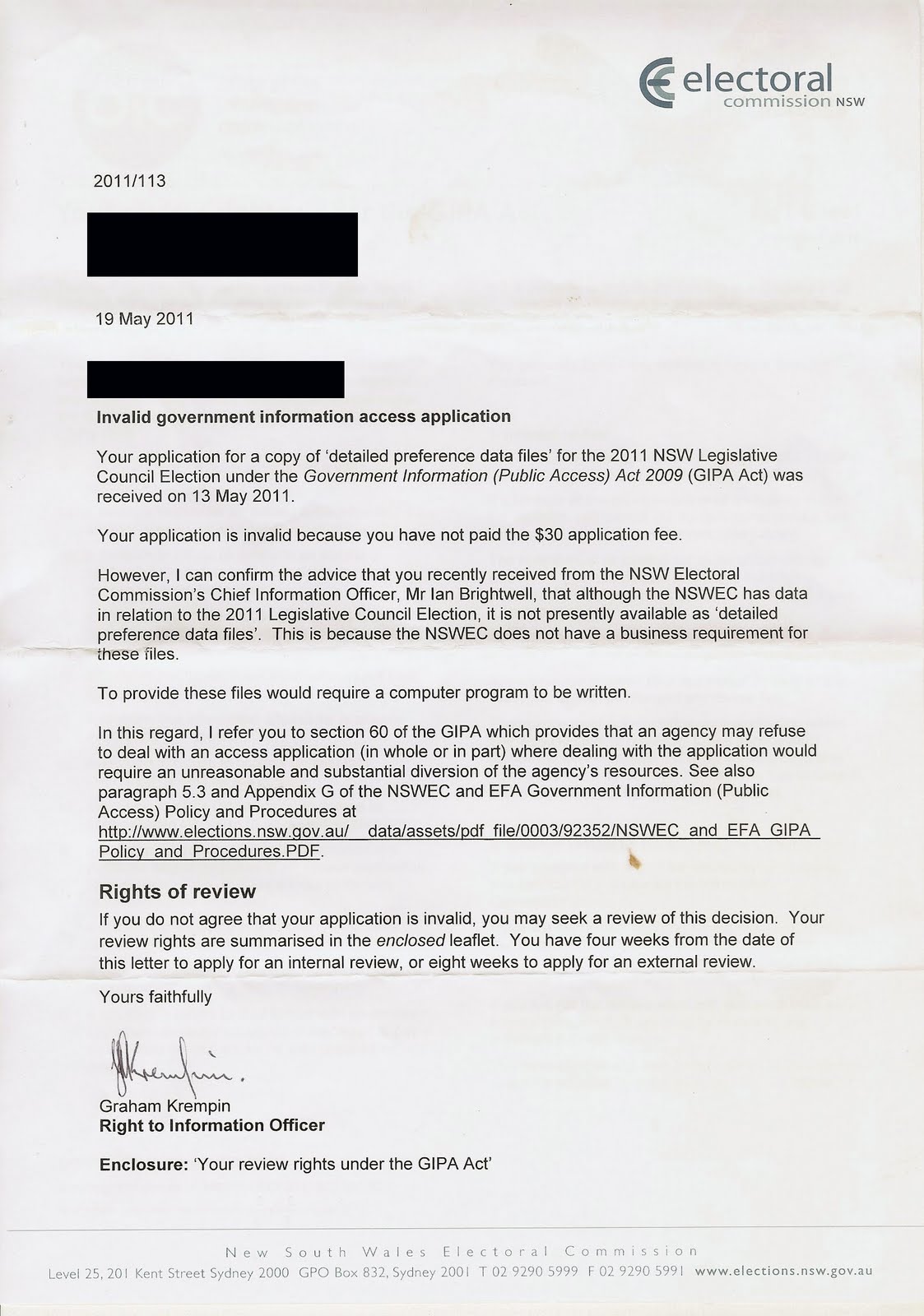
At first the Commission claimed the data files did not exist, Then when we made a submission under the NSW Information Act the Commission refused to consider the application as the prescribed $30.00 application fee had not been paid.

A second application, which included the payment of the prescribed fee, was made along with a request for details on the software certification documentation. This second request was submitted on July 5, 2011 (Received on July 7, 2011).

The Commission under the provision of the NSW information Act had until July 26 to respond. Come July 27 no response was received. So we immediately lodged an application for review by the NSW Office of Information Commission expressing our ongoing concern at the Electoral Commissions misuse and abuse of process.

On August 1, 2011 (some five days late) the NSW Electoral Commission finally replied to our FOI application, stating that the information requested has been published by the Commission and was now available on the NSW Electoral Commission's Web site.

The location of this data is not easy to find as it is hidden away within the context of the Commission's summery  A direct link to the data can be found here.


Review of the data published indicates that this information was available late June but was not notified until August 2011.

In a further example of inefficientcy, and what we consider may be a further attempt to again avoid scrutiny and accountability, the information published was over 3Giga Bytes in size and excluded details of ballot papers that recorded duplicate preference numbers or had preferences missing. Why this information was excluded is anyone guess?


The Commission went to extraordinary steps to filter out and expand the data file so that the data file provided was excessively large, much larger then was required or necessary. Instead of one record per ballot paper, as requested, the commission demonstrated just how inefficient its data management is that it decided to produce a data file that included a single record per preference. Causing the data file to be some 100 times bigger than would otherwise be required.

It also turns out the Commission’s software had been modified after the2011 State election. Certification documentation provided, dated June 2011. indictates that amendments had been made to correct a number of errors in the original software.

The software, costing taxpayers 10's of millions of dollars, was developed in India. (Why Australian Developers were not used uis another issue?) Software that is, effectively, a duplication of software that already exists and is used by the Australian Electoral Commission.

OK, It is recognised that the NSW electoral provisions do differ from the Senate electoral provision but the cost of modifying the AEC software would not have been anywhere near the amount of money spent by the NSW Electoral Commission in having India . There are still unanswered questions as to who owns the intellectual property rights and copy right of the software developed?

After a three month delay we still do not have a full set of data. Some of the issuing or duplicate preference data could have been a result of data-entry errors. Without access to the full data set we are prevented from undertaking a full and more comprehensive analysis or review.
On a more positive side, more like an admission of guilt then a jester of good will, the Commission refunded the $30 application fee.

The question still remains why was this data not made available during the data entry process? Why has it taken them so long to publish the data? . And why did they opt to publish only a subset of the data and it in such an inefficient format?

We hope the mistakes of the Commission will not be repeated in future public elections and that Parliament takes a long and serious hard look at the role of the NSW Electoral Commission and legislation pertaining to the method of counting our votes.


Name Size Last Modified
File:2011 LC FP First Preference Results by District-Grp-Candidate v1.xls 1013 KB 3/08/2011 19:26:00
File:Functional Requirements for Vote Count v3 2 - changes accepted.pdf 310 KB 19/07/2011 17:03:00
File:PRCC Fn Spec v3.1 Certificate of Legislative Compliance.pdf 23 KB 19/07/2011 17:37:00
File:PRCC Fn Spec v3.2 Certificate of Legislative Compliance - Final.pdf 164 KB 29/07/2011 13:09:00
File:PRCC LC Birlasoft Test Certificate v3.2.pdf 181 KB 20/07/2011 13:38:00
File:PRCC LG Birlasoft Test Certificate v3.2.pdf 177 KB 20/07/2011 13:38:00
File:Readme.doc 34 KB 13/07/2011 19:32:00
File:SGE 2011 LC Preferences.zip 636988 KB 29/06/2011 16:44:00

Tuesday, June 14, 2011

Hanson a victim of fraud. Yet NSW EC continues to deny access to BTL vote data

Pauline Hanson vote challenge has been derailed with evidence lead in court that the allegation of missing votes was fraudulent.  (ABC News).  Mr. Sean Castle, the man behind the fraudulent allegations is likely to face court costs associated with Hanson challenge after he admitted to faking the allegations but will escape public prosecution in return for goving evidence..

"Mr Castle, a father of three, was granted protection from prosecution before being compelled to answer questions relating to the purported Electoral Commission email.

Under questioning, he said "he had never received any email from the commission and that he had created it himself". He also admitted he has never known anyone who has worked for the Electoral Commission."


Notwithstanding Hanson's case the NSW Electoral commission still has failed to publish details of the Below-the-line election results which continue to bring the NSW EC into disrepute

Saturday, June 11, 2011

Pauline Hanson: Source of allegations of 'Dodgy vote counting' by NSW Electoral Commission confronts court

Not to be denied the thrills and spill, a man who claims he is the source of allegations made against NSW Electoral Commission has fronted court to give evidence. The man whose real name is Sean Castle used a pseudonym ‘Michael Rattner’. when he first contacted Pauline Hanson with revelations of a 1,200 vote discrepancy in the NSW election count. It was claimed that the staff had miscounted the votes that should have been allocated to Pauline Hanson instead they were discarded as informal.

The allegation of "dodgy vote counting" comes on the back of the NSW Electoral Commission's refusal to publish the detailed below-the-line preference computer data-files which were used to tabulate the results of the March election.  Without access to this data it is impossible to verify the correctness and validity of the election count.

Public elections MUST be open and transparent if public confidence is to be maintained in the electoral process.  The failure of the NSW election commission to publish this data has and continues to bring the Commission into disrepute and leave then open to allegations of corruption.

The NSW Court case has been adjourned until next week

Thursday, June 9, 2011

Missing witness, missing votes and missing data - Please explain?

Missing Witness

Pauline Hanson's court case has suffered a set back as her star witness to allegations of corruption and dodgy electoral practices against the NSW Electoral Commission failed to show up in court.

Missing Votes

Pauline Hanson is challenging the integrity and results of the 2011 NSW State election in which Ian Brightwell has been implicated in claims that he had sent out a eMail alleging that 1,200 votes for Ms Hanson had been miscounted..

Missing Data

Could Ian Brightwell, please explain why the NSW EC has refused to publish details of the below-the-line preference data files that were used to determine the results of the NSW State upper house election?  This information should have been publicly available and subject to scrutiny?  The detailed preference file for the NSW Senate election have been published why not the State?  Without access to this data it is impossible to verify the integrity of the computer count.

The conduct of public elections must be open and transparent. The results of the NSW Election most certainly is not open or transparent. Why has the Commission refused to published the data file and subject it to public scrutiny? What does the NSW Electoral Commission have to hide?

Tuesday, May 31, 2011

Corruption Allegations Against NSW Electoral Commission

Pauline Hanson, Former leader of One Nation, has alleged that she was denied election at the 2011 NSW State election as a result of corruption in the way the count has been counted.  This raises serious concern about the conduct of the election itself and the ability of its Chief Commissioner Colin Barry.  The NSW Commission has also come under criticism for failing to publish the detailed results of the election.  It is crucial that elections are open and transparent in order to maintain public confidence.  Colin Barry's has failed in both accounts.  Elections in Australia are no longer open or transparent. The commission's refusal to release detailed elections results only undermines public confidence even further.  Colin Barry';s approach is to deny access to crucial evidence and information.  This is not the way to proceed.  The NSW State government must insist in a full independent audit of the commissions management and practices.  If Colin Barry is unable or unwilling to ensure that elections are open and transparent then he should resign or be dismissed.

Monday, May 30, 2011

Commission seeks to deny public access to detailed results: More questions raised about NSW Electoral Software

The NSW Electoral Commission has once again gone to extraordinary steps to try and avoid disclosure of detailed election results racing ongoing concerns as to the design, structure and certification of the NSW Electoral Commission's software


In what is seen a further example of misuse and abuse of process the Commission falsely claims that copies of the below the line preference data files used to tabulate and calculate the results of the State election can not be made available.  The Commission claims that in order to do so they would need to write a program to extract the data.

This has raised a number of questions as to the design structure and security of the software deployed by the commission.  Presumably the information is stored in a commonly used database storage format such as Microsoft access, SQL, MSSQL or similar.  Any computer person who is familiar with the data structure should be able to write SQL query to extract the data within 5-10 mins.  Bare in mind that the NSW Electoral Commission has an "qualified" IT team, one finds it extremely difficult to believe that the Commission is unable or unwilling to responded to the formal FOI request in good faith.

The request made to the Commission had requested that the FOI application fee be waived as the information sought is in the public interest.

Given the extraordinary effort made by the commission to avoid disclosure we wonder exactly what is it they are seeking to hide and prevent being made public?  Perhaps this is an issue that the NSW Corruption Commission or the Auditor General should investigate.


Public elections MUST be open and transparent, the information sought is readily available from all other Australian electoral commissions that data-entry preference data.  Why not NSW?

Thursday, May 19, 2011

Collin Barry's Secret Ballot: Blackjack with the cards faced down

NSW Election Commissioner, Colin Barry's refusal to publish the detailed results of the NSW state election upper house ballot is akin to a blackjack dealer dealing a deck of cards face down and then declaring the results without showing the cards.

What is it he has to hide.  Why has he refused to published the ballot election data files?

Colin Barry's actions continue to bring the conduct of the 2011 NSW State election into disrepute and open to allegations of fraud and corruption.

Elections conducted by computers counts are no longer open and transparent,  Publication of the data file should be undertaken progressively during the count as was the case during the 2008 Melbourne City Council Election.

Tuesday, May 17, 2011

Colin Barry Denies Dodgy Poll allegations

Colin Barry, NSW Chief Electoral Commissioner, has denied Pauline Hanson's allegations of electoral fraud.  Courier Mail by Kate Sikora.
 

"A day after the matter was in the Court of Dispute Returns, Electoral Commissioner Colin Barry issued a statement refuting the claims, made by Ms Hanson.

The claims surrounded two staff members, Ian Brightwell and Richard Carroll, who are alleged to have exchanged emails regarding errors in the count of votes for Ms Hanson, who lost a seat in NSW Parliament’s Upper House by 1300 votes.

"Nothing has been shown to me that suggests the allegation concerning the staff members has any substance,’’ Mr Barry said."


Meanwhile Colin Barry has failed to respond to an FOI request for copies of the computerised below-the-line preference data-files.  The Commissioner's refusal to publish this data continued to bring t6eh conduit of the Commission and Marches State Election into disrepute. 

NSWEC information Manager, Ian Brightwell, was quick to act in order to prevent the publication of the preference data files? The question remains unanswered is why? .

Copies of the Below-the-line data files are published by all other Electoral Commissions, Including the AEC NSW Senate count,  

Ian Brightwell raises questions as to integrity of NSW poll

Ian Brightwell, Information manager for the NSW Electoral Commission, has been implicated as a source of information in allegations of dodgy staff (Australian Newspaper)

When contacted by The Australian for comment, Mr Brightwell hung up the phone.

Ian Brightwell is the same person we spoke to in seeking to gain access to the recorded "Below-the-line" preference data-files  Mr Brightwell was very evasive and refused to publish the data files.  Data that is normally published by other Electoral Commissions as a mater of course.

Why the secrecy and coverup?  Could there be some truth and fact behind the allegation of dodgy staff involved in a conspiracy to pervert the course of justice and the validity of the election?

Why is crucial information such as the BTL data-files not being made available? Why is the NSW Electoral Commision engaged in a act of avoidance?

The Australian news article  says the Electoral Commission is investigating the allegations.  This is akin to the fox being put in charge of the investigation of the raid on the hen house.

The NSW Electoral Commission must be subjected to a full independent inquiry with the allegations of corruption investigated independently from the Commission itself.  The investigation needs to also look into the question as to why the Commission is refusing to publishers details of the election results.


If, as suggested, there is wrong doing in the way the NSW election has been conducted then Colin Barry, Chief Electoral Commissioner should be removed from office.

It is fundamental that the public have full confidence in the Electoral process and that public elections are open and transparent.

Monday, May 16, 2011

Pauline Hanson wins rights of discovery motion on conduct of election.

Pauline Hanson, candidate in the 2011 NSW Legislative Council election, has been granted under a "notice of discovery" the right to obtain information pertaining to the conduct of the NSW Upper House election. Pauline Hanson failed to win a position in the NSW Legislative Council by less then 1,300 votes. 

"This is not just about Pauline Hanson, We should have a fair and just system in Australia and ensure all elections are above board.'' Pauline Hanson  told reporters.


Colin Barry, NSW Electoral Commissioner, has refused to make available or publish copies of the below the line preference data files used to calculate and determine the outcome of the election.


There is nothing in law that prevents details of the election results or the preference data file being published. It is a public document.

So why is Colin Barry refusing to make this information publicly available?

Copies of the preference data-files are published by other Electoral Commissions, including the NSW Senate vote conducted by the Australian Electoral Commission. 

It is essential that our election process is open and transparent
Without access to the data it is impossible to verify the correctness of validity of a computerised election count.  The content of the data file has not been subject to public scrutiny or review.There is no guarantees that it is a true and accurate record of the voters intentions.

Colin Barry's refusal to make this information available has and continues to bring the NSW election into disrepute.

Thursday, May 5, 2011

Pauline Hanson challenges NSW election result

Pauline hanson has challenged the results of the NSW upper-house election. Whilst I do not support Pauline Hanson's polices or politics I do support the challenge.  This is an issue that Pauline Hanson should take to the High Court if need be.

The NSW Commissioner, in refusing to publish the detailed below the line preference data files, has cast doubt over the electoral process. If public confidence is to be restored the preference data files must be published and readily available for independent public review.

Australian should be very concerned about the lack of transparency in the NSW election.  Was there unfair manipulation of the election results?


The system of counting the upper house vote in NSW is seriously flawed with a random selection of ballot papers determining the result.  This system should have been abolished long ago as it does not accurately represent the voters intention.

There is little wonder why Colin Barry, NSW chief Electoral Commission refuses to publish the below the line preference data files as it would highlight the flaws in the system,  Flaws that he and the NSW parliament should have addressed.

Colin Barry's refusal to publish the data is now the subject of an FOI request and a complaint to the Information Ombudsman. The Commissioner's failure to ensure that the electoral system is open and transparent has raised questions as to the property of the election count itself.  One ask what is it that he has to hide  and why has he refused to make the data files public?


The Australian Electoral Commission and the Victorian Electoral Commission have all published the below the line preference data files.  Why not NSW?

The NSW Electoral Commission's web site has little to desire.  Colin Barry clearly has done little to  improve NSW procedures.  One has to again question the value and need for State ElectoralCcommissions,  They clearly lack expertise and professionalism.


A quick read of schedule 6 of the NSW Election Act shows just how distorted and seriously flawed the NSW election system is. This would have to be one of the worst electoral codes in Australia.

Thursday, April 21, 2011

Conduct of NSW election brought into disrepute

The conduct of the NSW State election has been brought into disrepute with the State Electoral Authority refusing to publish copies of the detailed preference data file.

Without access to this data it is impossible to verify the accuracy and integrity of the NSW State election. Copies of the preference data files are published (belatedly) by the Australian Electoral Commission and other state jurisdictions.

Electronic records are subject to modification and possible corruption. Publication of the data files limits opportunity for the data files being altered and changed.

The fact that the NSW electoral commission has refused to make this information available raises the obvious question why?

ABUSE OF PROCESS.

The detailed data file is a public document and as such is subject to an FOI application. The requirement for an FOPI application and the payment of $30.00 fee is an abuse of process. This information should be freely available and on the public record. It is not an onerous task. The information can and should be accessible visa a download from the NSWEC web site.


The NSWEC information policy states

In addition to the “open access information” the NSWEC also proactively releases other information.
...

Make an informal request

If the information you are after has not already been published, but is information which raises no particular concerns in terms of possible public interest reasons why it should be kept confidential, then the NSWEC may be able to release it to you on request without the formalities of having to make a formal application.
If you think this applies to the information you are after you can contact us to make an informal request.
Generally, we try to release information we hold without the need for you to make a formal access application, unless there are good reasons to require one.

We had made an informal request and also contacted Ian Bright, Manager of Information Technology, and was told in no uncertain words that this information is not available. 

We are left with no other option but to make an application and pay the fee to obtain information that should be readily and freely available.