Colin Barry, NSW Chief Electoral Commissioner, has denied Pauline Hanson's allegations of electoral fraud. Courier Mail by Kate Sikora.
"A day after the matter was in the Court of Dispute Returns, Electoral Commissioner Colin Barry issued a statement refuting the claims, made by Ms Hanson.
The claims surrounded two staff members, Ian Brightwell and Richard Carroll, who are alleged to have exchanged emails regarding errors in the count of votes for Ms Hanson, who lost a seat in NSW Parliament’s Upper House by 1300 votes.
"Nothing has been shown to me that suggests the allegation concerning the staff members has any substance,’’ Mr Barry said."
Meanwhile Colin Barry has failed to respond to an FOI request for copies of the computerised below-the-line preference data-files. The Commissioner's refusal to publish this data continued to bring t6eh conduit of the Commission and Marches State Election into disrepute.
NSWEC information Manager, Ian Brightwell, was quick to act in order to prevent the publication of the preference data files? The question remains unanswered is why? .
Copies of the Below-the-line data files are published by all other Electoral Commissions, Including the AEC NSW Senate count,

Tuesday, May 17, 2011

Ian Brightwell raises questions as to integrity of NSW poll
Ian Brightwell, Information manager for the NSW Electoral Commission, has been implicated as a source of information in allegations of dodgy staff (Australian Newspaper)
When contacted by The Australian for comment, Mr Brightwell hung up the phone.
Ian Brightwell is the same person we spoke to in seeking to gain access to the recorded "Below-the-line" preference data-files Mr Brightwell was very evasive and refused to publish the data files. Data that is normally published by other Electoral Commissions as a mater of course.
Why the secrecy and coverup? Could there be some truth and fact behind the allegation of dodgy staff involved in a conspiracy to pervert the course of justice and the validity of the election?
Why is crucial information such as the BTL data-files not being made available? Why is the NSW Electoral Commision engaged in a act of avoidance?
The Australian news article says the Electoral Commission is investigating the allegations. This is akin to the fox being put in charge of the investigation of the raid on the hen house.
The NSW Electoral Commission must be subjected to a full independent inquiry with the allegations of corruption investigated independently from the Commission itself. The investigation needs to also look into the question as to why the Commission is refusing to publishers details of the election results.
If, as suggested, there is wrong doing in the way the NSW election has been conducted then Colin Barry, Chief Electoral Commissioner should be removed from office.
It is fundamental that the public have full confidence in the Electoral process and that public elections are open and transparent.
When contacted by The Australian for comment, Mr Brightwell hung up the phone.
Ian Brightwell is the same person we spoke to in seeking to gain access to the recorded "Below-the-line" preference data-files Mr Brightwell was very evasive and refused to publish the data files. Data that is normally published by other Electoral Commissions as a mater of course.
Why the secrecy and coverup? Could there be some truth and fact behind the allegation of dodgy staff involved in a conspiracy to pervert the course of justice and the validity of the election?
Why is crucial information such as the BTL data-files not being made available? Why is the NSW Electoral Commision engaged in a act of avoidance?
The Australian news article says the Electoral Commission is investigating the allegations. This is akin to the fox being put in charge of the investigation of the raid on the hen house.
The NSW Electoral Commission must be subjected to a full independent inquiry with the allegations of corruption investigated independently from the Commission itself. The investigation needs to also look into the question as to why the Commission is refusing to publishers details of the election results.
If, as suggested, there is wrong doing in the way the NSW election has been conducted then Colin Barry, Chief Electoral Commissioner should be removed from office.
It is fundamental that the public have full confidence in the Electoral process and that public elections are open and transparent.
Monday, May 16, 2011
Pauline Hanson wins rights of discovery motion on conduct of election.
Pauline Hanson, candidate in the 2011 NSW Legislative Council election, has been granted under a "notice of discovery" the right to obtain information pertaining to the conduct of the NSW Upper House election. Pauline Hanson failed to win a position in the NSW Legislative Council by less then 1,300 votes.
Colin Barry, NSW Electoral Commissioner, has refused to make available or publish copies of the below the line preference data files used to calculate and determine the outcome of the election.
There is nothing in law that prevents details of the election results or the preference data file being published. It is a public document.
So why is Colin Barry refusing to make this information publicly available?
Copies of the preference data-files are published by other Electoral Commissions, including the NSW Senate vote conducted by the Australian Electoral Commission.
It is essential that our election process is open and transparent
Without access to the data it is impossible to verify the correctness of validity of a computerised election count. The content of the data file has not been subject to public scrutiny or review.There is no guarantees that it is a true and accurate record of the voters intentions.
Colin Barry's refusal to make this information available has and continues to bring the NSW election into disrepute.
"This is not just about Pauline Hanson, We should have a fair and just system in Australia and ensure all elections are above board.'' Pauline Hanson told reporters.
Colin Barry, NSW Electoral Commissioner, has refused to make available or publish copies of the below the line preference data files used to calculate and determine the outcome of the election.
There is nothing in law that prevents details of the election results or the preference data file being published. It is a public document.
So why is Colin Barry refusing to make this information publicly available?
Copies of the preference data-files are published by other Electoral Commissions, including the NSW Senate vote conducted by the Australian Electoral Commission.
It is essential that our election process is open and transparent
Without access to the data it is impossible to verify the correctness of validity of a computerised election count. The content of the data file has not been subject to public scrutiny or review.There is no guarantees that it is a true and accurate record of the voters intentions.
Colin Barry's refusal to make this information available has and continues to bring the NSW election into disrepute.
Thursday, May 5, 2011
Pauline Hanson challenges NSW election result
Pauline hanson has challenged the results of the NSW upper-house election. Whilst I do not support Pauline Hanson's polices or politics I do support the challenge. This is an issue that Pauline Hanson should take to the High Court if need be.
The NSW Commissioner, in refusing to publish the detailed below the line preference data files, has cast doubt over the electoral process. If public confidence is to be restored the preference data files must be published and readily available for independent public review.
Australian should be very concerned about the lack of transparency in the NSW election. Was there unfair manipulation of the election results?
The system of counting the upper house vote in NSW is seriously flawed with a random selection of ballot papers determining the result. This system should have been abolished long ago as it does not accurately represent the voters intention.
There is little wonder why Colin Barry, NSW chief Electoral Commission refuses to publish the below the line preference data files as it would highlight the flaws in the system, Flaws that he and the NSW parliament should have addressed.
Colin Barry's refusal to publish the data is now the subject of an FOI request and a complaint to the Information Ombudsman. The Commissioner's failure to ensure that the electoral system is open and transparent has raised questions as to the property of the election count itself. One ask what is it that he has to hide and why has he refused to make the data files public?
The Australian Electoral Commission and the Victorian Electoral Commission have all published the below the line preference data files. Why not NSW?
The NSW Electoral Commission's web site has little to desire. Colin Barry clearly has done little to improve NSW procedures. One has to again question the value and need for State ElectoralCcommissions, They clearly lack expertise and professionalism.
A quick read of schedule 6 of the NSW Election Act shows just how distorted and seriously flawed the NSW election system is. This would have to be one of the worst electoral codes in Australia.
The NSW Commissioner, in refusing to publish the detailed below the line preference data files, has cast doubt over the electoral process. If public confidence is to be restored the preference data files must be published and readily available for independent public review.
Australian should be very concerned about the lack of transparency in the NSW election. Was there unfair manipulation of the election results?
The system of counting the upper house vote in NSW is seriously flawed with a random selection of ballot papers determining the result. This system should have been abolished long ago as it does not accurately represent the voters intention.
There is little wonder why Colin Barry, NSW chief Electoral Commission refuses to publish the below the line preference data files as it would highlight the flaws in the system, Flaws that he and the NSW parliament should have addressed.
Colin Barry's refusal to publish the data is now the subject of an FOI request and a complaint to the Information Ombudsman. The Commissioner's failure to ensure that the electoral system is open and transparent has raised questions as to the property of the election count itself. One ask what is it that he has to hide and why has he refused to make the data files public?
The Australian Electoral Commission and the Victorian Electoral Commission have all published the below the line preference data files. Why not NSW?
The NSW Electoral Commission's web site has little to desire. Colin Barry clearly has done little to improve NSW procedures. One has to again question the value and need for State ElectoralCcommissions, They clearly lack expertise and professionalism.
A quick read of schedule 6 of the NSW Election Act shows just how distorted and seriously flawed the NSW election system is. This would have to be one of the worst electoral codes in Australia.
Thursday, April 21, 2011
Conduct of NSW election brought into disrepute
The conduct of the NSW State election has been brought into disrepute with the State Electoral Authority refusing to publish copies of the detailed preference data file.
Without access to this data it is impossible to verify the accuracy and integrity of the NSW State election. Copies of the preference data files are published (belatedly) by the Australian Electoral Commission and other state jurisdictions.
Electronic records are subject to modification and possible corruption. Publication of the data files limits opportunity for the data files being altered and changed.
The fact that the NSW electoral commission has refused to make this information available raises the obvious question why?
ABUSE OF PROCESS.
The detailed data file is a public document and as such is subject to an FOI application. The requirement for an FOPI application and the payment of $30.00 fee is an abuse of process. This information should be freely available and on the public record. It is not an onerous task. The information can and should be accessible visa a download from the NSWEC web site.
The NSWEC information policy states
We had made an informal request and also contacted Ian Bright, Manager of Information Technology, and was told in no uncertain words that this information is not available.
We are left with no other option but to make an application and pay the fee to obtain information that should be readily and freely available.
Without access to this data it is impossible to verify the accuracy and integrity of the NSW State election. Copies of the preference data files are published (belatedly) by the Australian Electoral Commission and other state jurisdictions.
Electronic records are subject to modification and possible corruption. Publication of the data files limits opportunity for the data files being altered and changed.
The fact that the NSW electoral commission has refused to make this information available raises the obvious question why?
ABUSE OF PROCESS.
The detailed data file is a public document and as such is subject to an FOI application. The requirement for an FOPI application and the payment of $30.00 fee is an abuse of process. This information should be freely available and on the public record. It is not an onerous task. The information can and should be accessible visa a download from the NSWEC web site.
The NSWEC information policy states
In addition to the “open access information” the NSWEC also proactively releases other information.
...
Make an informal request
If the information you are after has not already been published, but is information which raises no particular concerns in terms of possible public interest reasons why it should be kept confidential, then the NSWEC may be able to release it to you on request without the formalities of having to make a formal application.
If you think this applies to the information you are after you can contact us to make an informal request.
Generally, we try to release information we hold without the need for you to make a formal access application, unless there are good reasons to require one.
We had made an informal request and also contacted Ian Bright, Manager of Information Technology, and was told in no uncertain words that this information is not available.
We are left with no other option but to make an application and pay the fee to obtain information that should be readily and freely available.
Friday, April 15, 2011
Steve Tully's Information revolution under fire
The Victorian Electoral Commission has come under criticism for its management of the electoral role with many citizens complaining that the VEC has made false allegations against citizens in relation to voting irregularities to which the Commission is now seeking to take legal action.
Under Steve Tully, Chief Electoral Commissioner, the Victorian Electoral Commission has become the new stasi of State Government departments. The VEC is renowned for its half baked poor data administration. Crucial data records pertaining to the 2006 State election were deleted and destroyed with no copies or backups recorded.
The VEC administration is in disarray and there is a serious need for a open parliamentary review.
In the lead up to the 2010 State election the VEC, who had been granted access to private and confidential information from a range of government databases, had sent out notices to non-citizens telling them they had to enrol vote.
Steve Tully recently came under fire by Victorian Senator Scott Ryan who described the heavy handed approach taken by the Chief Commissioner in collecting data as the slippery slope for individuals loss of privacy.
Unknown to most and without any oversight the VEC has been compiling a massive database of names and private contact details.
Steve Tully, in what has been described as a fascist lust and zeal for power, has access to vast amounts of confidential private information from the Residential Tenancies bond authority, Vic Roads, Local Council rate notices, Library memberships, Educational Department student records and other sources. the VEC maintain this information on its database where there are little security to protect this information from misuse and abuse. Even private "Silent Enrollment listings are accessed for purposes that are not related to the conduct of the election. There is no record or monitoring who access the data records stored and for what purposes.
Steve Tulley has been given unfettered access to confidential information Information that should not be readily available. The VEC has then processed this information in a rather haphazard manner. there are numerous examples of mismanagement, misuse and abuse of information collected and held by the VEC including allegations that VEC staff have accessed the confidential information held for purposes not related to the issuing and casting of votes.
The recent stuff ups in administration are just the tip of the iceberg
The Attorney General needs to initiate a major audit and review of information technology and the information collected by the VEC.
Steve Tully should resign following the recent outrage
The problem that Steve Tully and the VEC data boffins have not realised is that the address used for electoral purposes does not need to be the same address used for Motor Registration or rental agreements, rate notices etc.
There is only one sources of information that can and should be relied on when determining who should be entitled to vote.
Birth Deaths and Citizenship records.
The only other requirements that the VEC needs to verify is the residential address in order to determine which electorate a person is entitled to be registered.
Questions need to be asked how confidential are you electoral details and why does the VEC need access to the detailed electoral role in the first place.
The Australian Electoral Commission has overall responsibility for the maintenance of the electoral rile. Why has the VEC been granted unfettered access to the rile data including Silent enrolment entitlements.
Under Steve Tully, Chief Electoral Commissioner, the Victorian Electoral Commission has become the new stasi of State Government departments. The VEC is renowned for its half baked poor data administration. Crucial data records pertaining to the 2006 State election were deleted and destroyed with no copies or backups recorded.
The VEC administration is in disarray and there is a serious need for a open parliamentary review.
In the lead up to the 2010 State election the VEC, who had been granted access to private and confidential information from a range of government databases, had sent out notices to non-citizens telling them they had to enrol vote.
Steve Tully recently came under fire by Victorian Senator Scott Ryan who described the heavy handed approach taken by the Chief Commissioner in collecting data as the slippery slope for individuals loss of privacy.
Unknown to most and without any oversight the VEC has been compiling a massive database of names and private contact details.
Steve Tully, in what has been described as a fascist lust and zeal for power, has access to vast amounts of confidential private information from the Residential Tenancies bond authority, Vic Roads, Local Council rate notices, Library memberships, Educational Department student records and other sources. the VEC maintain this information on its database where there are little security to protect this information from misuse and abuse. Even private "Silent Enrollment listings are accessed for purposes that are not related to the conduct of the election. There is no record or monitoring who access the data records stored and for what purposes.
Steve Tulley has been given unfettered access to confidential information Information that should not be readily available. The VEC has then processed this information in a rather haphazard manner. there are numerous examples of mismanagement, misuse and abuse of information collected and held by the VEC including allegations that VEC staff have accessed the confidential information held for purposes not related to the issuing and casting of votes.
The recent stuff ups in administration are just the tip of the iceberg
The Attorney General needs to initiate a major audit and review of information technology and the information collected by the VEC.
Steve Tully should resign following the recent outrage
The problem that Steve Tully and the VEC data boffins have not realised is that the address used for electoral purposes does not need to be the same address used for Motor Registration or rental agreements, rate notices etc.
There is only one sources of information that can and should be relied on when determining who should be entitled to vote.
Birth Deaths and Citizenship records.
The only other requirements that the VEC needs to verify is the residential address in order to determine which electorate a person is entitled to be registered.
Questions need to be asked how confidential are you electoral details and why does the VEC need access to the detailed electoral role in the first place.
The Australian Electoral Commission has overall responsibility for the maintenance of the electoral rile. Why has the VEC been granted unfettered access to the rile data including Silent enrolment entitlements.
Monday, February 7, 2011
Poll: Gillard preferred PM treading water as Abbott sinks
Julia Gillard has maintained her lead in the preferred Prime-Minister stakes according the latest Newspoll published in the Australian.
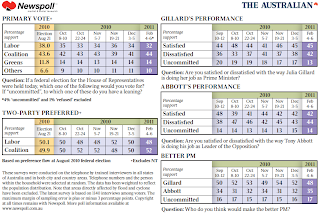 Gillard is is reported as having a satisfied rating of 45% (up one percent since September 2010). The down side is that the undecided rating (down down to 13% from 20% in September ) has swung to the negative with a corresponding rise in the satisfied category.
The swing has not helped Tony Abbott who is still languishing behind Gillard as preferred Prime Minster. (48% to 35%)
Abbott satisfaction rating has dropped six percentage points from 48% to 42% with a corresponding increase in the level of those dissatisfied with Abbott's performance (38% to 44%) the number of uncommitted remains at 13%
The bias Green Doctor of Tea Leaf reading William Bowie (Pollbludger) in a quantum leap in assessing a poll published by Roy Morgan reports that Abbott's decline is due to a rise in treasure Joe Hocking standing. It has nothing to do with Abbott's inability to win over the public's trust and confidence.
The swing has not helped Tony Abbott who is still languishing behind Gillard as preferred Prime Minster. (48% to 35%)
Abbott satisfaction rating has dropped six percentage points from 48% to 42% with a corresponding increase in the level of those dissatisfied with Abbott's performance (38% to 44%) the number of uncommitted remains at 13%
The bias Green Doctor of Tea Leaf reading William Bowie (Pollbludger) in a quantum leap in assessing a poll published by Roy Morgan reports that Abbott's decline is due to a rise in treasure Joe Hocking standing. It has nothing to do with Abbott's inability to win over the public's trust and confidence.
Subscribe to:
Posts (Atom)